
Some businesses are built on efficiency.
Some are built on scale.
And then there are businesses built on meaning.
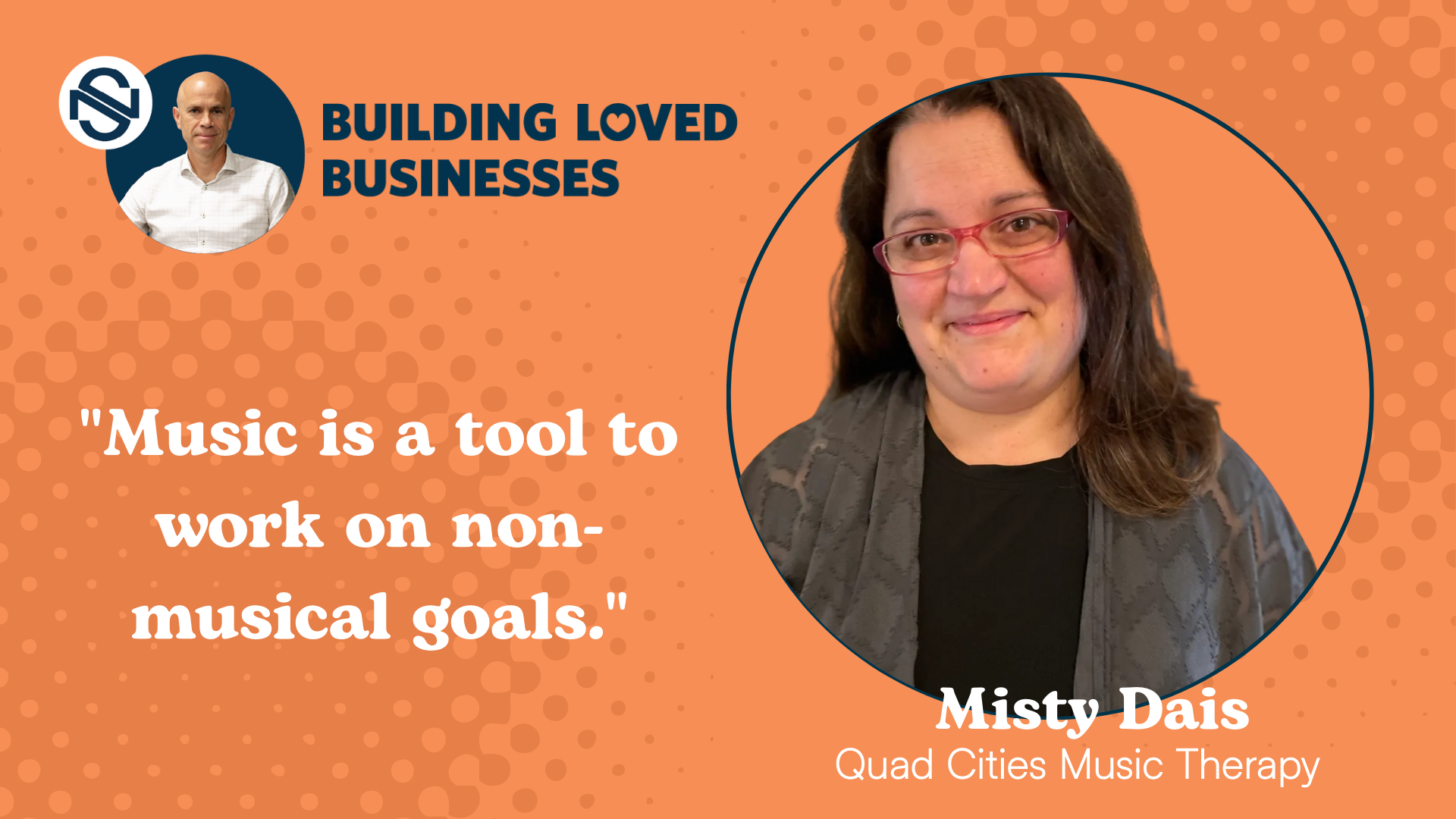
On this episode of Building Loved Businesses, I had the chance to sit down with Misty Dais, the founder and owner of Quad Cities Music Therapy, and her story sits right at the intersection of art, therapy, and entrepreneurship.
Misty doesn’t use music to create musicians.
She uses music to help people communicate, regulate emotions, build motor skills, gain confidence, and connect with others in deeply human ways.
And the way she’s built her business is a masterclass in purpose-driven growth.
Music as a Tool, Not the Goal
When I asked Misty to explain what music therapy actually is, she described it simply—but powerfully.
Music isn’t the destination.
It’s the vehicle.
Through drumming, singing, movement, and instruments, Misty and her team work on non-musical goals like communication, attention, executive functioning, and emotional regulation. Much of their work supports children and adults with autism, Down syndrome, cerebral palsy, and other intellectual or developmental disabilities.
What struck me most is that this isn’t experimental or anecdotal—it’s research-based therapy with roots going back to World War II.
Music works because it’s universal. It’s motivating. And neurologically, it activates multiple areas of the brain at once—something few tools can do as effectively.
A Business That’s Always in Motion
Behind Misty, during our conversation, wasn’t a Zoom background—it was her actual space.
Quad Cities Music Therapy operates out of a vibrant music center in Moline that feels alive even when it’s quiet. On any given week, they’re running:
- Individual and small-group music therapy sessions
- Early childhood music programs
- Adaptive rock bands
- Traditional and adaptive music lessons
- Cardio drumming and group classes
And that’s just inside the building.
Misty’s team also works across the community—inside schools, special education classrooms, and assisted living facilities, bringing music directly to the people who need it most.
It’s a complex operation.
And it didn’t start this way.
A Calling That Started Early—and Traveled the World
Misty’s path into music therapy started long before she ever thought about owning a business.
As a kid, she loved music—all of it. Piano. Voice. Flute. Choir. Band. If it made sound, she wanted to learn it.
In high school, a visiting college mentor introduced her to a career she’d never heard of before: music therapy. It immediately clicked. Helping people + music = purpose.
She earned her degree at Western Illinois University and completed her internship at a private music therapy practice in Wisconsin, where she learned not just the work—but the business side of private practice.
Then life intervened.
Marriage.
The Air Force.
Moves across the country—and overseas.
In Washington State, she helped launch a music therapy program through United Cerebral Palsy. In Germany, she focused on raising her four children and homeschooling—an experience that quietly shaped her teaching and leadership style in ways that would matter later.
Starting Small—Really Small
When Misty and her family finally landed in the Quad Cities in 2017, she knew she wanted to return to music therapy. She just didn’t know when.
That moment came when her husband was between jobs.
Instead of waiting for certainty, Misty started in a room in her house.
Clients came through the door.
Piano students.
Oboe students.
Music therapy sessions in a home studio.
Like so many loved businesses, Quad Cities Music Therapy began small—built on trust, skill, and word of mouth.
Choosing Entrepreneurship for Flexibility and Freedom
Misty could have worked for someone else.
She chose not to.
With four children and a desire to control her schedule, she wanted flexibility—not just for convenience, but for presence. And she wanted creative freedom.
If she had an idea, she wanted to try it.
No board approvals.
No permission slips.
Just responsibility.
That freedom came with a steep learning curve. Misty knew music—but business, marketing, hiring, and systems were new territory. She leaned into books, podcasts, coaching programs, and constant learning—Donald Miller, The E-Myth Revisited, operations systems, and industry-specific resources.
The learning never stopped.
Growing Through a Pandemic—Boldly
Quad Cities Music Therapy officially launched in 2018.
Then came 2020.
An in-person, community-based business faced with a global shutdown.
Misty pivoted to virtual sessions, upgraded equipment, and did what she could for families who were able to continue. Some paused services altogether.
But in late 2020—while uncertainty still hung in the air—Misty made a bold move.
She rented a commercial space.
Not because things were easy.
Because she believed in the future.
Looking back, she admits it was a leap of faith—but it was the right one.
Partnerships That Multiply Impact
One of the most powerful parts of Misty’s growth story is how she’s used partnerships to expand both reach and impact.
She’s worked for years with GiGi’s Playhouse, a Down Syndrome Achievement Center, helping launch programs like an adaptive rock band that now includes 10 participants and performs publicly throughout the year.
She collaborates with organizations like the Cancer Support Community, not just by providing services—but by actively helping identify and secure grant funding so nonprofits can afford high-quality programming.
Her approach isn’t transactional.
It’s collaborative.
And it’s allowed Quad Cities Music Therapy to serve more people than a single business ever could on its own.
Hiring for Purpose, Not Just Skill
As the business grew, Misty faced her biggest challenge: hiring.
This isn’t just music instruction.
It’s life-changing work.
In interviews, Misty always asks the same questions:
What does music mean to you?
How has it changed your life?
Why do you want to teach?
She’s patient—sometimes choosing waitlists over hiring the wrong person—because purpose matters more than speed.
And families feel that difference.
Learning to Work On the Business
As we talked, Misty was refreshingly honest about her biggest leadership struggle: letting go.
She loves the work.
She loves the clients.
And for a long time, she spent too much time in the business.
The result?
Burnout.
Stagnation.
Growth didn’t happen until she stepped back, delegated, and focused on the work only she could do—vision, partnerships, systems, and leadership.
That shift is ongoing.
And it’s necessary.
A Vision That Keeps Expanding
Today, Misty is thinking bigger again.
In the next 3–5 years, she envisions:
- A second location
- A nonprofit arm to provide low-cost or free services
- An inclusive arts community offering music, art, movement, and life-skills programming
It’s a big vision.
And it started, years ago, in a notebook titled: She believed she could, so she did.
The Impact That Makes It All Worth It
Before we wrapped up, I asked Misty about impact.
She shared a moment that says everything.
A grandmother stopped her in the grocery store to thank her—because music was what helped her grandson cope with anxiety during COVID. When everything else felt uncertain, music gave him grounding.
That’s what this business does.
It builds joy.
It builds confidence.
It changes lives.
Final Thought
Misty’s story is a reminder that loved businesses aren’t built by accident.
They’re built by people who:
- Follow a calling
- Learn what they don’t know
- Lead with purpose
- And are willing to evolve as the business grows
Quad Cities Music Therapy isn’t just teaching music.
It’s creating connection.
And that’s what building a loved business is all about.
To learn more about Quad Cities Music Therapy, visit quadcitiesmusictherapy.com or follow them on Facebook. If you’re outside the area, you can find a local provider through the American Music Therapy Association.