
One of the most common stories I hear from business owners starts the same way:
They’re exceptionally good at what they do.
They’re talented, hardworking, and passionate about their craft.
And then one day they decide to start a business.
What often comes next is something few people anticipate. Instead of creating a business, they create a demanding job for themselves.
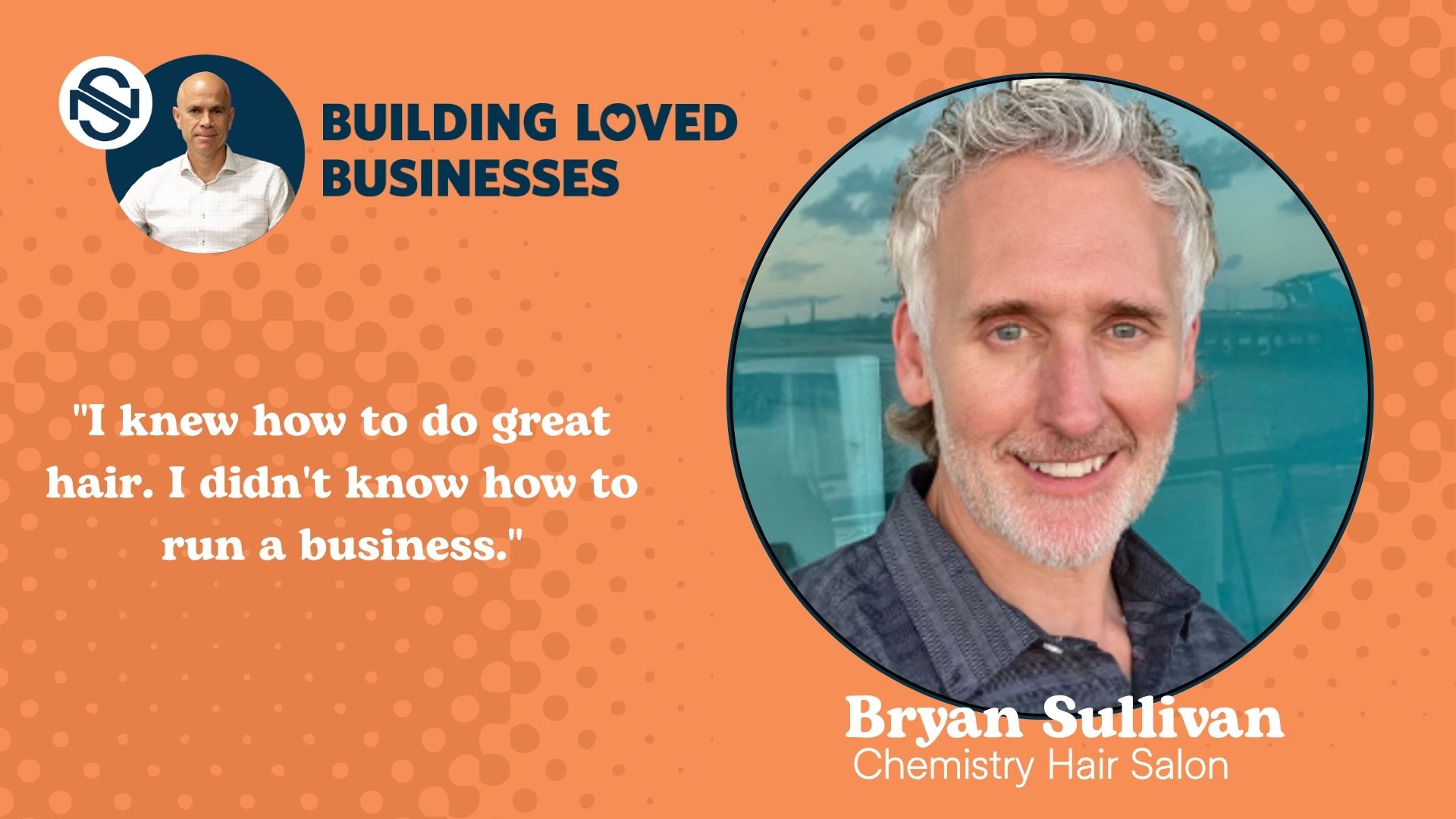
That’s exactly where Bryan Sullivan found himself.
In a recent conversation on Building Loved Businesses, Bryan shared the remarkable journey of growing Chemistry Hair Salon in Shreveport, Louisiana, from a four-chair salon into a market-leading company with two locations, more than 30 service providers, and a leadership team that’s preparing the business for growth beyond its founder.
What stood out wasn’t just the growth itself.
It was how Bryan had to transform as a leader to make that growth possible.
Success Isn’t the Same as Sustainability
When Bryan first opened Chemistry Hair Salon, business was good.
In fact, it was very good.
The problem was that the business depended almost entirely on him.
He was working six ten-hour days every week. He was training staff, serving clients, managing operations, paying bills, and carrying the weight of the entire company on his shoulders.
As Bryan described it, he was working 60-plus hours a week before he even opened a letter or wrote a check.
Many business owners know exactly what that feels like.
You’re generating revenue.
You’re busy.
You’re growing.
But you’re also exhausted.
And deep down, you know the business can’t function without you.
That’s not a business.
That’s a job with a lot more risk attached to it.
The Moment Everything Changed
The turning point came when Bryan realized he didn’t know how to run a business.
He knew how to create exceptional experiences for clients.
He knew how to teach and develop stylists.
But he didn’t know how to build systems, manage financials, or create a company that could scale.
So he did something many entrepreneurs struggle to do.
He asked for help.
After hearing other successful salon owners talk about coaching and business systems, Bryan invested in a Summit Salon Systems seminar. He didn’t really have the money for it. The investment went on a credit card.
But what he gained was clarity.
For the first time, he had a roadmap.
Instead of guessing, he had systems.
Instead of reacting, he had metrics.
Instead of hoping things would improve, he had a plan.
That’s a lesson every business owner can learn from.
Growth doesn’t happen because we work harder.
Growth happens when we learn how to work differently.
What Gets Measured Gets Improved
One of the biggest shifts Bryan made was learning to manage the business through numbers instead of intuition.
Many entrepreneurs operate from their bank account.
If there’s money available, things seem fine.
If there isn’t, there’s a problem.
The challenge is that your bank balance doesn’t tell you what’s actually driving success.
Bryan learned to track the key metrics that mattered most in his business and to use those metrics to guide decisions.
Over time, that discipline helped Chemistry grow from roughly a $300,000 company into a business generating more than $2 million annually.
The lesson isn’t about revenue.
It’s about visibility.
When you understand your numbers, you gain the ability to improve them.
Great Businesses Take Care of Their People First
One of the things I appreciated most about Bryan’s philosophy is his belief that employees come first.
Not because customers don’t matter.
But because employees are the people serving customers every day.
As Bryan put it, his primary responsibility is taking care of his team so they can take care of clients.
That philosophy shows up throughout Chemistry’s business model.
They provide healthcare benefits.
They offer retirement matching.
They invest heavily in education and professional development.
They create clear career paths for stylists.
And they spend significant time coaching team members to help them achieve their own goals.
The result isn’t just better employee retention.
It’s a stronger customer experience.
People who feel cared for tend to care more deeply about the people they serve.
Stop Being the Hero
One insight Bryan shared really resonated with me.
He talked about learning that as an owner, your job isn’t to be everyone’s hero.
Your job is to help other people become heroes.
That’s a difficult transition for many founders.
In the early stages of a business, being the hero works.
You solve every problem.
You answer every question.
You step in whenever something goes wrong.
But eventually, that approach becomes the bottleneck.
Growth requires leaders who can coach, develop, and empower others.
As Bryan said, founders eventually have to trade the cape for the compass.
That’s when organizations begin to scale.
Building Something That Lasts
Perhaps the most impressive part of Bryan’s story is what he’s building now.
After years of carrying the company himself, he’s preparing Chemistry Hair Salon to thrive without him.
He’s created a shareholder structure that allows key team members to buy into ownership.
He’s developing future leaders.
He’s building systems that can survive leadership transitions.
And he’s working through a ten-year succession plan designed to ensure the business continues long after he retires.
That’s what building a loved business looks like.
It’s not simply creating something successful.
It’s creating something sustainable.
It’s building a company that serves customers, develops people, creates opportunities, and continues creating value for years to come.
Final Thoughts
Bryan’s journey is a powerful reminder that successful founders don’t have all the answers.
They stay curious.
They ask questions.
They seek coaching.
They invest in learning.
And perhaps most importantly, they continue evolving.
The skills required to start a business are not the same skills required to scale one.
The founder who launches the company isn’t always the same leader who grows it.
And that’s okay.
In fact, that’s often exactly what growth requires.
If you’re currently feeling trapped by your business, overwhelmed by responsibility, or wondering how you’ll ever get out from underneath the demands of ownership, take heart.
You don’t have to figure it all out alone.
The next stage of growth may begin with something as simple as asking for help.
And that decision might just change everything.