
One of the patterns I see over and over again in truly loved businesses is this:
They don’t start with a clever business plan.
They start with pain.
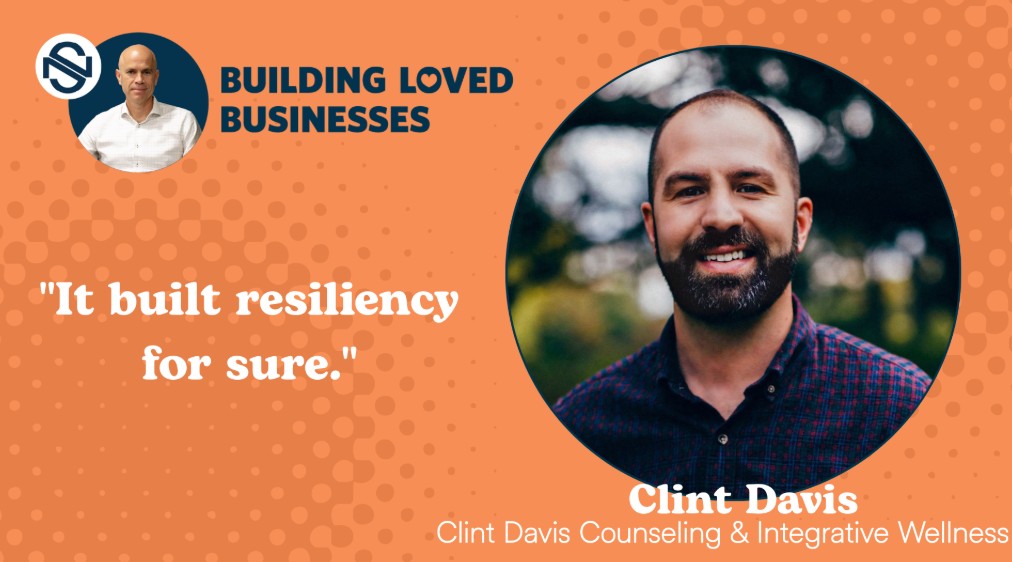
In a recent episode of Building Loved Businesses, I sat down with Clint Davis, founder of Clint Davis Counseling and Integrated Wellness, and his story is a powerful example of that truth.
Clint didn’t set out to build a multi-location counseling practice with more than two dozen clinicians. He set out to survive. And then, eventually, to help others do the same.
A Business Born Out of the Work of Healing
Clint grew up in a small town in Louisiana, joined the National Guard, and found himself in the middle of some of the most intense experiences a human being can go through—9/11, Afghanistan, Hurricane Katrina. Like many veterans, he came home carrying trauma he didn’t yet have language for.
What changed his life wasn’t a strategy or a system.
It was counseling.
As Clint told me, learning about trauma and PTSD in the early 2000s didn’t just help him function—it gave him hope. And that hope became a calling. He went back to school, earned his degree in marriage and family therapy, and committed his life to helping others heal emotionally, spiritually, and relationally.
What struck me wasn’t just what he built, but how he built it.
Leadership Formed in Fire
When Clint eventually started his private practice in 2017, he didn’t have a business coach, a growth plan, or a spreadsheet telling him what to do next.
He had a full caseload, a deep desire to help people, and—by his own admission—very little idea how to run a business.
And yet, the business grew.
Not because Clint optimized margins or chased scale, but because there was a real need—and because people trusted him.
Along the way, he learned the lessons most founders learn the hard way:
- Hiring without clarity
- Paying people before understanding overhead
- Underestimating taxes
- Avoiding hard conversations
- Confusing kindness with leadership
What impressed me most was his honesty. Clint doesn’t tell a story of overnight success. He tells a story of making mistakes, adjusting, and slowly growing into the leader his people needed him to be.
That’s the real work of entrepreneurship.
A Different Definition of Success
One of the most powerful moments in our conversation came when Clint talked about how he measures success.
Not by revenue.
Not by headcount.
Not by how many clients walk through the door.
But by hope.
He told me that when things feel uncertain—when money is tight or change is happening—he tries to keep his hope anchored in something deeper than the business itself. That posture shows up everywhere in how he leads.
Today, Clint’s practice includes:
- Three locations
- More than 25 clinicians
- A mix of licensed therapists and biblical counselors
- A growing presence in churches, schools, first responder organizations, and the broader community
But what really stood out to me was this:
At their most recent Christmas party, Clint looked around the room and realized he would trust anyone on his staff to care for his own family.
That doesn’t happen by accident.
Why Community Beats Individual Success
Clint is clear about something many leaders miss:
Therapy isn’t the end goal. Community is.
He doesn’t want clients—or employees—to depend on him forever. He wants them to build lives filled with deep, honest relationships where healing continues long after the counseling session ends.
That same philosophy shows up in how he leads his team.
Clint intentionally creates space every week for:
- Accountability
- Confession
- Hard conversations
- Emotional honesty
- Spiritual formation
He told me something every business leader needs to hear:
“I have no secrets in my life.”
Seven to ten people know his struggles, his doubts, his failures. And because of that, he can lead from a place of peace instead of fear.
In a world where many CEOs feel isolated, pressured to appear infallible, and quietly overwhelmed, that kind of leadership is rare—and incredibly powerful.
What Business Leaders Can Learn from Counseling
We often talk about employee engagement, retention, and culture as if they’re operational challenges.
Clint reframed it simply:
People want to know they matter.
They want to belong.
They want to be seen as whole human beings.
That means leaders have to wrestle with hard questions:
- How much more should I really make than my employees?
- Am I building something sustainable—or just profitable?
- Would I be proud to show my team the full picture?
Clint’s approach isn’t about perfection. It’s about integrity.
And that’s why people stay.
Looking Ahead
Clint is now launching a nonprofit aimed at better integrating churches, counselors, and communities—creating shared language, shared resources, and healthier pathways for long-term healing.
It’s an ambitious vision. And fittingly, he’s holding it loosely.
As he put it, casting vision matters—but so does humility. Leaders who leave room for change are leaders who can actually adapt when life happens.
Why This Story Matters
Clint Davis didn’t build his business by chasing success.
He built it by doing the work—on himself first.
And that’s the common thread I see in businesses that are truly loved:
- The leader is willing to grow
- The culture is built on trust
- The purpose goes deeper than profit
Those are the businesses worth building.
Those are the stories worth telling.
And those are the leaders our communities desperately need more of.