
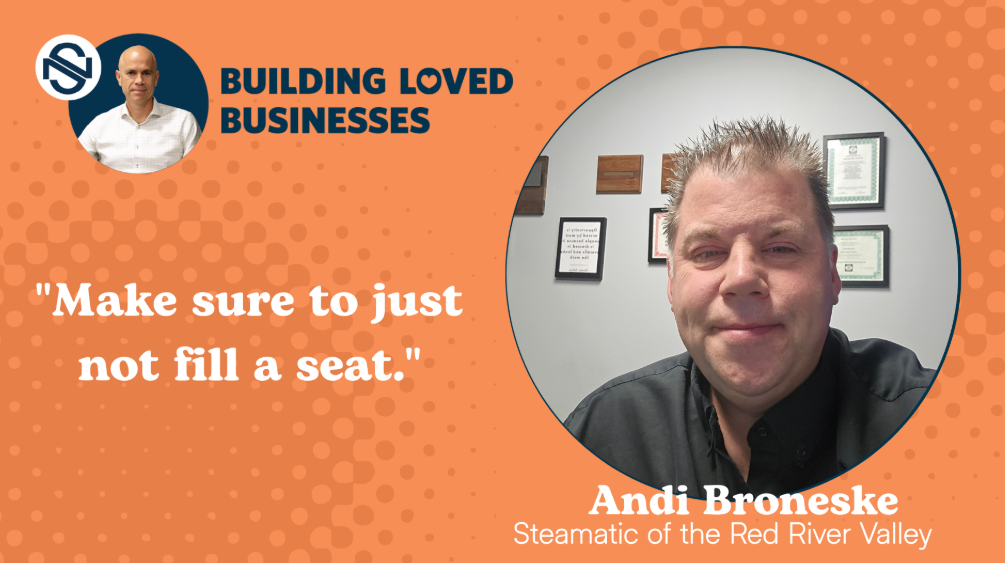
On a recent episode of Building Loved Businesses, host Nathan Schock sat down with Andi Broneske, Branch Manager and Estimator at Stomatic in Fargo, North Dakota.
What followed was more than a conversation about restoration work. It was a story about sacrifice, second chances, leadership, and why empathy—not just expertise—is the foundation of a truly loved business.
Betting on Himself
Andi’s journey into the restoration industry didn’t start with a grand plan.
After high school, he turned down a full-ride football scholarship, deciding instead to take a year off. During that time, he worked a full-time job delivering appliances and cleaned carpets on nights and weekends.
Then tragedy struck: his brother passed away.
That loss changed everything.
“It kind of hit me—life’s too short. Either you jump into life full throttle, or you don’t.”
So he jumped.
He sold his personal vehicle to buy a truck mount system, printed flyers, and started building a carpet cleaning business. He co-owned it with his mother and grew it over nine years into a thriving operation with multiple team members.
But ownership came with weight.
The Hidden Cost of Ownership
From the outside, entrepreneurship looks freeing. You control your destiny. You make the decisions. You build something of your own.
From the inside? You wear every hat.
- Estimator
- Scheduler
- Technician
- Equipment manager
- HR
- Accounts payable
- Customer service
- Sales
- Collections
And when payroll comes due on Friday, employees get paid first—whether business was slow or not.
Andi remembers working 7 a.m. to 2 a.m. during a major flood in Fargo, chasing opportunity and revenue. He told himself he was building a better future for his family.
But one day he came home and realized his young daughter was saying new words he’d never heard before.
He had missed them.
That moment hit harder than any financial stress.
Success without balance carries a cost.
Choosing Family Over “Blue Sky”
Eventually, Andi made a difficult decision: sell the business.
Selling wasn’t simple. In the service industry, the value of a company is deeply tied to relationships. Buyers told him plainly:
“Your company isn’t as valuable without you.”
So he agreed to stay on for 18 months after the sale to ensure a smooth transition and protect client relationships.
The process required transparency:
- Sharing profit-and-loss statements
- Evaluating assets
- Negotiating real value vs. “blue sky” (what we feel our company is worth)
And when the deal closed, he stepped into something new—being an employee again.
From Competitor to Teammate at Stomatic
After leaving the company that purchased his business, Andi eventually joined Stomatic, owned locally by Marcus (who had built the business over nearly three decades).
What made it different?
Alignment.
Marcus shared Andi’s vision for service, integrity, and people-first leadership. Today, Andi is approaching his 10th year with Stomatic.
When he started, the Fargo branch had about six team members. Today:
- ~25 team members in Fargo
- ~65 team members across Fargo and Grand Forks
But growth wasn’t accidental.
And it wasn’t rushed.
Cleaning with Empathy
Stomatic handles fire damage, water loss, mold remediation, commercial duct cleaning, and large-scale disaster restoration. They respond 24/7—even at 2 a.m. on Christmas morning.
And when that phone rings, it’s rarely someone having a good day.
As Andi puts it:
“We see people at their worst.”
Imagine:
- A flooded basement
- A house fire
- A hotel sprinkler system bursting
- Mold discovered behind walls
- A family displaced overnight
Now imagine two strangers showing up at your door at 2 a.m., asking you to trust them inside your home.
That’s why Andi looks for one trait above all when hiring:
Empathy.
Not just technical skill.
Not just certifications.
Not just experience.
Empathy.
Because empathy:
- Builds trust faster than credentials
- Calms chaos
- Creates belonging within a team
- Elevates ordinary work into meaningful service
One simple example? Stomatic uses clear garbage bags when removing damaged items—so homeowners can see what’s being taken from their home.
That small detail communicates respect.
A Pizza That Built Loyalty
One story perfectly captures their culture.
Andi responded to a flooded basement where a mother was overwhelmed. Her husband was away. The kids were crying. Dinner hadn’t happened.
When he asked, “How can we help you today?” her answer wasn’t about water extraction.
“I need someone to make dinner.”
So he ordered pizza.
No charge.
No upsell.
No contract adjustment.
Just help.
They couldn’t solve the restoration problem until they first solved the human one.
That family never forgot it.
Growing Without Losing What Made You Special
Today, Stomatic continues to expand. But Andi is cautious about growth.
“The reason a company expands is because people liked something. When you expand, make sure you don’t lose what that was.”
Too many businesses grow by:
- Filling seats instead of finding the right people
- Scaling revenue but shrinking culture
- Training for tasks but not values
Stomatic hires differently.
In interviews, they ask:
“What do you do with your grocery cart when you’re done?”
It sounds simple—but it reveals character.
Because leadership isn’t about being watched.
It’s about doing the right thing when no one is looking.
What Business Owners Can Learn from Andi’s Journey
- Ownership isn’t freedom without boundaries.
You must intentionally design balance—or the business will consume it. - Selling isn’t failure.
Sometimes it’s wisdom. - Alignment matters more than title.
The right team can be more fulfilling than being “the boss.” - Empathy scales better than ego.
Especially in service industries. - Growth should protect culture, not dilute it.
Rebuilding More Than Buildings
At its core, Stomatic isn’t just in the restoration business.
They restore:
- Homes
- Businesses
- Trust
- Stability
- Peace of mind
And sometimes… they restore dinner.
If you’re building a business today, ask yourself:
Are you just delivering a service?
Or are you solving a human problem?
Because the businesses people truly love don’t just fix things.
They care.