
If you’re looking for a flashy, overnight-success story—this isn’t it.
But if you want to understand what it actually takes to build a business that customers trust, employees respect, and communities rely on… this is exactly that.
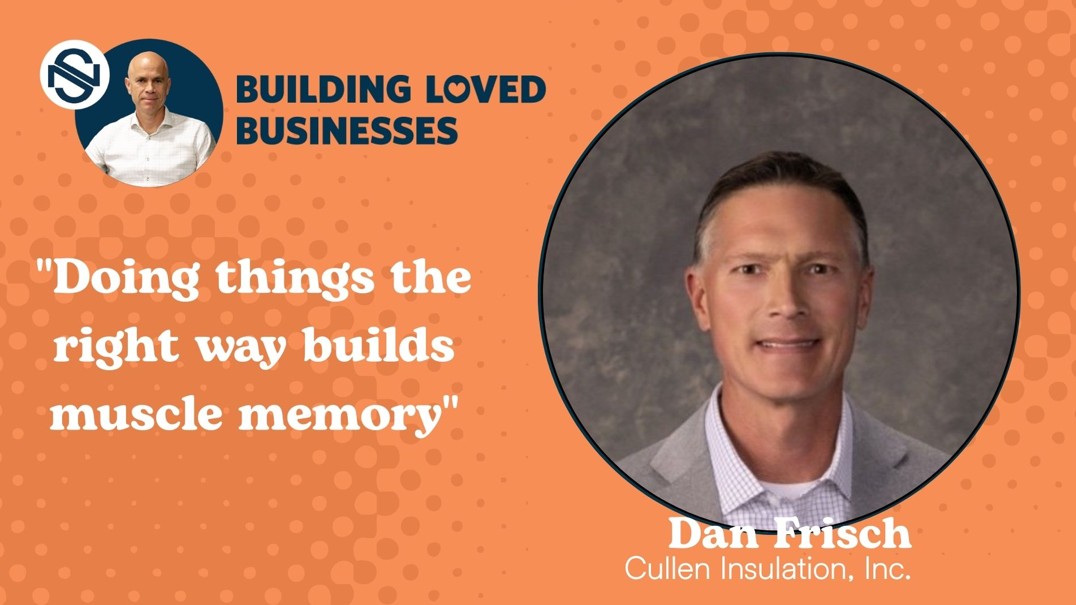
In a recent episode of Building Loved Businesses, I sat down with Dan Frisch, co-owner and president of Cullen Insulation. His journey didn’t start with a grand vision of running a multi-location construction company. In fact, it started as what he thought would be a short-term, transitional job.
That “transition” is now 30 years in the making.
And buried inside Dan’s story are a few lessons that every business owner needs to hear.
You Don’t Have to Start With the Perfect Plan
Dan didn’t set out to work in construction.
He studied business, explored investment banking, and even shifted toward long-term care administration. His first job out of college? A corporate role that had him sitting in a cubicle all day.
It didn’t last long.
An opportunity came up to help his former hockey coach with a small insulation business—five employees, scrappy operations, and plenty of unknowns. Dan stepped in, planning to stay temporarily.
But something clicked.
He wasn’t just doing one job—he was doing everything.
Estimating. Invoicing. Working in the field. Solving problems. Even catching stray cats in the warehouse.
That’s the thing about small businesses: they don’t offer clarity at the beginning—but they offer ownership.
And ownership is what makes people stay.
Growth Doesn’t Come From Strategy Alone—It Comes From Trust
Today, Cullen Insulation has grown to around 90 employees across multiple locations.
That kind of growth doesn’t happen by accident. But it also doesn’t happen purely because of strategy decks and expansion plans.
It happens because of trust.
Dan talked about his partnership with Eric, his co-owner. If you’ve been around business long enough, you know partnerships can go sideways fast.
Their secret?
They trust each other—and they talk constantly.
Not occasionally. Not when things go wrong. Constantly.
They also understand their differences:
- One is detail-oriented
- One is more visionary
Instead of fighting that, they’ve built around it.
That’s what strong partnerships do—they multiply strengths instead of competing for control.
Expansion Isn’t the Goal—Excellence Is
A lot of business owners ask:
Should we expand into new markets?
Dan’s answer is refreshingly grounded.
They didn’t expand because it looked good on paper. They expanded because:
- Customers pulled them into new markets
- There was real demand
- They believed they could deliver quality
And even then—they made mistakes.
One of the biggest lessons?
Just because you can win the work doesn’t mean you should take it.
Early on, they took on too much too quickly in a new market. The result? Strained teams, risk to quality, and pressure on customer relationships.
Now, they operate differently:
Controlled growth beats aggressive growth. Every time.
Because in business, you don’t get unlimited second chances with customers.
Culture Isn’t Built in a Conference Room
One of the hardest challenges in scaling a business is maintaining culture across multiple locations.
It’s easy when you’re in one place. It’s hard when you’re spread out.
So how does Cullen do it?
They don’t overcomplicate it.
They lead by example.
- They show up early (5 a.m. early)
- They help their teams in the field
- They stay close to the work
- They reinforce the same standards everywhere
And when something isn’t working?
They fix it—even if that means changing leadership in a branch.
Because culture isn’t what you say—it’s what you consistently tolerate.
The Real “Secret” to Success Is… Boring
There’s a moment in the conversation where we talked about something that doesn’t get enough attention:
Success is repetitive.
It’s not built on big, exciting moments. It’s built on doing the same small things—over and over—at a high level.
Dan learned this from the company’s founder:
- Show up early
- Do the paperwork right
- Follow the process
- Pay attention to details
Even when you don’t feel like it.
That’s discipline.
And discipline is what separates businesses that last from businesses that flame out.
Take Care of People—Everything Else Follows
At the core of Cullen’s “recipe” is something simple:
Treat people the way you’d want to be treated.
It sounds obvious. It’s rarely practiced consistently.
For builders, that means:
- Hitting schedules
- Solving problems proactively
- Being reliable without needing to be chased
For homeowners, it means:
- Respecting their space
- Doing clean, careful work
- Solving real problems—not just completing tasks
Because here’s the reality:
Most customers can’t evaluate the technical quality of your work.
But they can always evaluate how you made them feel.
And that’s where trust is built.
Final Thought: Build Something Worth Loving
Dan doesn’t have a perfectly mapped-out 10-year plan.
He’s not chasing growth for growth’s sake.
Instead, his focus is simple:
- Get better at what they already do
- Take care of their people
- Deliver consistent quality
- Stay disciplined in the details
If they do that well?
Growth will take care of itself.
And that’s the heart of building a business people love.
Not chasing more.
But doing the small things right—long enough, and consistently enough—that people can’t help but trust you.